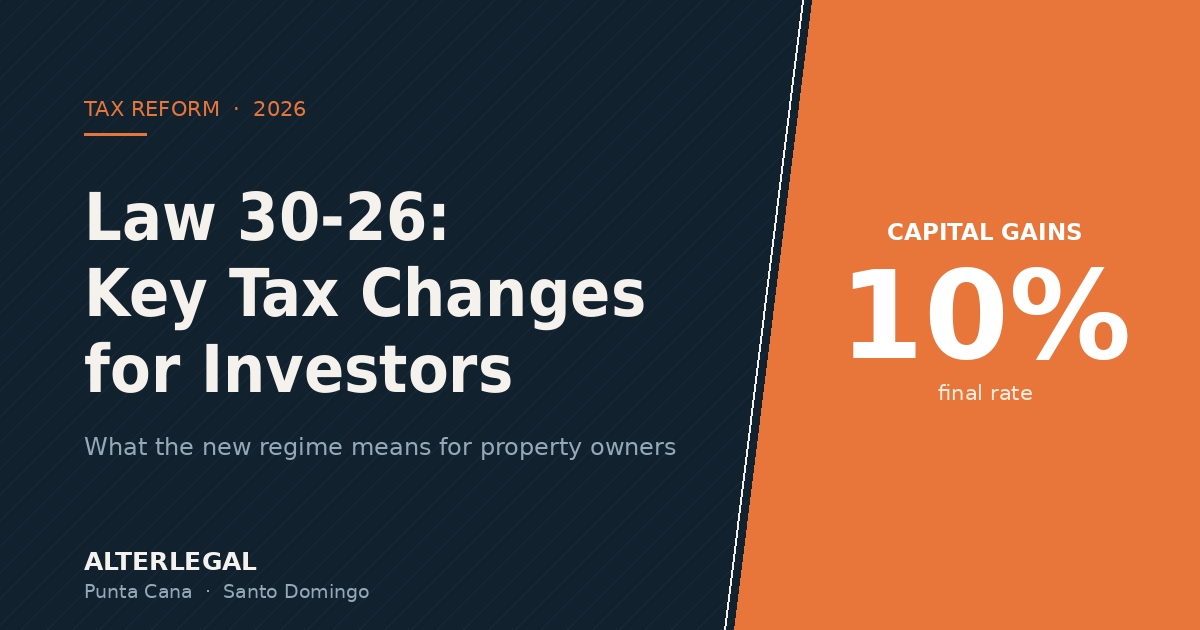
The enactment of Law No. 30-26 on 18 June 2026 marks one of the most significant tax reforms in the Dominican Republic in recent years. The legislation amends the Tax Code (Law 11-92), touching more than 20 laws and over 40 tax provisions, and introduces important changes affecting individuals, companies, real estate investors, and foreign investors with interests in the country.
For those investing in Dominican real estate, several of these measures represent a substantial improvement to the existing tax framework, while others require careful planning to minimize their impact. Below we summarize the most relevant changes.
1. Capital Gains Tax Reduced to a Final 10%
Perhaps the most significant change for real estate investors is the introduction of a single, final 10% tax on capital gains derived from the sale of real estate by individuals.
Previously, capital gains formed part of taxable income and could be subject to income tax rates of up to 27%. Under the new regime, sellers benefit from greater certainty and, in many cases, a substantially lower tax burden.
For investors considering future dispositions of real estate, this reform considerably improves the tax efficiency of selling property in the Dominican Republic. It is worth noting that the implementing regulation is still pending, and it will clarify how the taxable base is determined and which acquisition costs and documented improvements may be deducted.
2. Certain Real Estate Holding Companies May Also Benefit
Law 30-26 extends the same 10% capital gains regime to certain companies whose sole activity consists of the passive ownership of real estate.
This represents an important planning opportunity for investors who currently own, or intend to acquire, investment properties through corporate structures — whether a Dominican SRL or, in some cases, a U.S. or Canadian LLC. Eligibility depends on compliance with specific legal requirements, making proper corporate structuring more important than ever, along with awareness of the ongoing obligations that come with company ownership.
3. New Exemptions for Primary Residences
The reform also introduces favorable treatment for homeowners. Capital gains generated from the sale of a principal residence will be exempt from taxation when the proceeds are reinvested in another principal residence within six months.
Additionally, individuals over 65 years of age will benefit from a complete exemption on gains derived from the sale of their primary residence. These measures seek to encourage homeownership while providing additional protection to retirees.
4. Elimination of Certain Transaction Taxes
Another welcome development is the gradual elimination of several taxes affecting business and financing transactions. Beginning in 2027:
- The 1% tax on company incorporations and capital increases will be eliminated.
- Contributions consisting of real estate will continue to be subject to applicable transfer taxes.
- The 2% mortgage registration tax will be reduced to 1% in 2027 and eliminated entirely in 2028.
These changes reduce transactional costs and should facilitate corporate reorganizations and financing operations. For buyers budgeting a purchase today, they also affect the picture of the full cost of acquiring property.
5. Increase in the Banking Transactions Tax
Not every measure represents tax relief. Law 30-26 increases the tax applicable to checks and electronic bank transfers from 0.15% to 0.20%.
Although relatively modest, businesses and investors carrying out high-value transactions should consider this additional cost in their financial planning, particularly those who operate through a local bank account.
6. Reduced Withholding on Certain Cross-Border Payments
International businesses will also benefit from a reduction in withholding tax on certain outbound payments. Payments abroad relating to royalties, software licenses, digital advertising, and data storage and cloud services will now be subject to a 15% final withholding tax, replacing the previous 27% rate. This measure significantly reduces the cost of contracting many international digital services.
7. Higher Domestic Withholding Taxes
Conversely, the reform increases certain domestic withholding obligations. Among the most relevant:
- Rental payments to individuals increase from 10% to 15% as a final withholding tax.
- Professional fees, commissions, and personal services also increase from 10% to 15% as an advance payment of income tax.
Businesses should ensure that their accounting and payroll systems are updated accordingly. Owners who rent out their property short-term should pay particular attention to the change in rental withholding.
What Does This Mean for Real Estate Investors?
Overall, Law 30-26 introduces several positive developments for the Dominican real estate market. The reduction of the capital gains tax to 10%, together with new exemptions for primary residences and the extension of benefits to qualifying holding companies, significantly improves the country’s attractiveness for both local and foreign investors.
At the same time, the reform highlights the importance of reviewing existing ownership structures, tax planning strategies, and future exit plans to ensure that investors fully benefit from the new legal framework. It also sits alongside the incentives already available under the CONFOTUR regime, which many Punta Cana developments still qualify for.
Every investment structure is different, and the practical application of these rules will depend on each taxpayer’s specific circumstances, including the territorial taxation and fiscal residency rules that apply to foreign residents.
How AlterLegal Can Help
At AlterLegal, we regularly advise local and international clients on:
- Real estate acquisitions and dispositions
- Tax-efficient ownership structures
- Corporate reorganizations
- Due diligence
- Estate and succession planning
- Foreign investment
- Corporate law and regulatory compliance
If you own property in the Dominican Republic, or are considering investing, we would be pleased to discuss how Law 30-26 may affect your particular situation and identify opportunities available under the new legislation.
Need legal advice regarding Law 30-26? Our team is available to assist you in evaluating the impact of the new tax regime and implementing the most efficient legal structure for your investments.