How to Obtain Residency in the Dominican Republic: Investor, Rentier and Pensioner Options
The Dominican Republic has become an increasingly attractive destination for foreign investors, retirees, entrepreneurs, and individuals looking to establish a second home in the Caribbean.
For foreigners planning to live in the country on a long-term basis, obtaining legal residency can provide greater stability and simplify many aspects of life in the Dominican Republic.
Several residency options are available depending on the applicant’s financial and personal circumstances. Three of the most relevant alternatives for foreign nationals are:
- Residency by Investment
- Residency as a Rentier
- Residency as a Pensioner or Retiree
Each category has different financial thresholds, documentary requirements, and qualification criteria.
Below, we explain the main requirements and the general process for obtaining residency in the Dominican Republic.
1. Dominican Republic Residency by Investment
Foreign nationals who make a qualifying investment in the Dominican Republic may be eligible to apply for residency under the country’s special investment residency program.
Generally, the program requires a qualifying investment of at least US$200,000, or its equivalent in Dominican pesos.
The investment must be properly documented and recognized under the applicable Dominican foreign investment framework. Depending on the circumstances, qualifying investments may include capital contributions to Dominican companies, registered foreign investments, investments in qualifying tourism projects, free-zone companies, or other investments recognized by the competent authorities.
Does Buying Property in the Dominican Republic Qualify You for Residency?
This is an important distinction for foreign property buyers.
Purchasing real estate worth US$200,000 or more does not necessarily mean that the buyer automatically qualifies for residency by investment.
The structure of the investment and its ability to be properly registered and certified for immigration purposes must be reviewed.
For investors purchasing property in Punta Cana, Cap Cana, Casa de Campo, Santo Domingo, or elsewhere in the Dominican Republic, it is therefore advisable to coordinate the real estate transaction and immigration strategy before completing the investment.
Main Requirements for Investor Residency
Although requirements may vary depending on the applicant and the structure of the investment, the process generally requires:
- Valid passport with the required remaining validity.
- Dominican Residence Visa (RS).
- Long-form birth certificate, apostilled or legalized as applicable.
- Criminal background certificate from the applicant’s country of origin or country of residence, as applicable.
- Documentation regarding the applicant’s marital status.
- Documentation proving the qualifying investment.
- Certification of the foreign investment issued by the corresponding authority.
- Incorporation letter into the Foreign Investment Program, when applicable.
- Immigration guarantee insurance policy issued by an authorized insurer.
- Medical examinations performed through institutions authorized by the Dominican immigration authorities.
- Photographs and immigration forms required by the General Directorate of Migration.
The exact documentation should be confirmed before filing, particularly because the evidence required to establish the investment will depend on how the transaction was structured.
2. Dominican Republic Residency as a Rentier
Rentier residency is designed for individuals who receive stable, recurring income from sources outside the Dominican Republic.
Under Law No. 171-07, an applicant seeking to qualify as a rentier must generally demonstrate foreign-source income of at least:
US$2,000 per month.
Unlike investor residency, this category does not depend primarily on the amount invested in the Dominican Republic. Instead, the applicant must demonstrate a stable and qualifying source of foreign income.
What Income Can Qualify for Rentier Residency?
Depending on the circumstances, qualifying income may include income generated from:
- Foreign real estate.
- Dividends from foreign companies.
- Financial investments.
- Bank deposits or investment instruments.
- Other stable foreign-source income that can be properly documented.
The source, continuity, and amount of the income are important. Applicants should be prepared to provide supporting financial and legal documentation demonstrating that the income meets the applicable requirements.
Main Requirements for Rentier Residency
The application generally includes:
- Valid passport.
- Dominican Residence Visa (RS).
- Apostilled or legalized birth certificate.
- Criminal background certificate.
- Evidence of marital status.
- Evidence demonstrating at least US$2,000 in qualifying monthly foreign-source income.
- Bank statements and/or financial certifications.
- Documents demonstrating the source and continuity of the income.
- Immigration guarantee insurance policy.
- Medical examinations.
- Photographs and application forms required by Dominican immigration authorities.
Depending on the source of the income, additional corporate, banking, investment, or property documentation may be necessary.
3. Dominican Republic Residency for Pensioners and Retirees
The Dominican Republic also offers a special residency category for foreign retirees and pensioners who receive a qualifying pension from abroad.
This option can be particularly attractive for individuals planning to retire in the Dominican Republic, including those purchasing a home in Punta Cana, Cap Cana, Casa de Campo, or other areas of the country.
Under Law No. 171-07, the principal applicant must generally demonstrate a permanent pension of at least:
US$1,500 per month.
The pension may originate from a foreign government, official institution, or private entity, provided that it qualifies as a pension or retirement benefit under the applicable rules.
Ordinary employment income should not be confused with pension income for purposes of this category.
Can a Spouse or Dependents Be Included?
Yes. Qualifying dependents may generally be included in the residency process.
Under Law No. 171-07, the principal applicant must demonstrate an additional:
US$250 per month for each dependent.
Depending on the circumstances, qualifying dependents may include a spouse, minor children, and certain financially dependent children who meet the applicable requirements.
Main Requirements for Pensioner Residency
The process generally requires:
- Valid passport.
- Dominican Residence Visa (RS).
- Apostilled or legalized birth certificate.
- Criminal background certificate.
- Marriage certificate or other applicable civil-status documentation.
- Official certification confirming the pension.
- Documentation confirming the monthly pension amount.
- Dominican bank account certification, when required.
- Immigration guarantee insurance policy.
- Medical examinations.
- Photographs and immigration application forms.
Foreign documents generally need to comply with the applicable apostille or legalization requirements. Documents not issued in Spanish may also require an official translation.
Investor vs. Rentier vs. Pensioner Residency
The three categories can be summarized as follows:
| Residency Category | Main Financial Requirement | Generally Suitable For |
| Investor | Qualifying investment generally starting at US$200,000 | Foreign investors and business owners |
| Rentier | At least US$2,000/month in qualifying foreign-source income | Individuals with stable passive or investment income |
| Pensioner | At least US$1,500/month in qualifying pension income | Retirees receiving a pension from abroad |
For pensioners, an additional US$250 per month per qualifying dependent is generally required.
The appropriate residency category should not be determined solely by which financial threshold an applicant meets. The source of the funds, nature of the income, investment structure, available documentation, and family circumstances should also be reviewed.
Tax Benefits for Pensioners and Rentiers in the Dominican Republic
One of the reasons pensioner and rentier residency can be particularly attractive is Law No. 171-07, which establishes a special incentive regime for qualifying pensioners and foreign-source rentiers who establish residence in the Dominican Republic.
Subject to the specific requirements and limitations established by Dominican law, qualifying individuals may have access to benefits that can include:
- Exemption from the real estate transfer tax on the first qualifying property acquired in the Dominican Republic.
- A 50% reduction in certain mortgage-related taxes.
- A 50% reduction in Real Estate Property Tax (IPI), when applicable.
- Certain tax treatment applicable to dividends and interest.
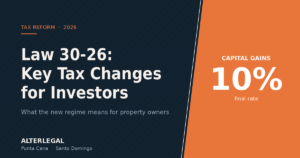
- A 50% exemption from capital gains tax when the statutory requirements are satisfied.
- Certain customs and tax benefits related to household goods and personal property.
- Certain tax benefits associated with the importation or acquisition of a vehicle, subject to the applicable conditions.
These benefits are not necessarily automatic merely because an individual obtains immigration residency. Eligibility should be reviewed separately based on the applicant’s circumstances and the requirements of Law No. 171-07 and the relevant tax authorities.
Step-by-Step Dominican Republic Residency Process
Although every application is different, the residency process generally follows several key stages.
Step 1: Determine the Correct Residency Category
Before collecting documents, the applicant should determine whether investor, rentier, pensioner, or another residency category is the most appropriate option.
This is particularly important for investors. The way an investment is structured can affect the documentation available for the immigration application.
Step 2: Collect Documents Abroad
Several documents will normally need to be obtained in the applicant’s country of origin or residence, including birth certificates, criminal background certificates, marriage certificates, and financial or pension certifications.
These documents may need to be apostilled or legalized before being used in the Dominican Republic.
Step 3: Obtain the Dominican Residence Visa
Applicants generally begin the immigration process by obtaining the appropriate Residence Visa (Visa de Residencia or RS) through the Dominican consular system.
This step should be coordinated before the applicant proceeds with the residency filing in the Dominican Republic.
Step 4: Prepare the Dominican Residency Application
Once the required foreign and Dominican documentation has been collected, the residency application is prepared and submitted through the procedures established by the Dirección General de Migración (DGM).
Step 5: Medical Examination and Immigration Requirements
The applicant must complete the medical examinations and other formalities required by Dominican immigration authorities.
Step 6: Immigration Review and Approval
The DGM reviews the documentation and determines whether the applicant satisfies the requirements for the requested residency category.
Processing times can vary depending on the category, documentation, government verification, and circumstances of each application.
Can You Apply for Dominican Residency While Buying Property?
Yes. Many foreign buyers coordinate their Dominican residency process with the purchase of property in the country.
However, the real estate purchase and immigration process should be treated as separate legal matters.
Buying property in the Dominican Republic does not, by itself, automatically grant residency.
For buyers who intend to qualify as investors, it is particularly important to evaluate the ownership and investment structure before closing the transaction.
For pensioners and rentiers, meanwhile, ownership of Dominican real estate may complement their relocation plans but qualification for residency will generally depend on their pension or foreign-source income rather than simply the value of the property purchased.
Do You Need a Lawyer to Apply for Residency in the Dominican Republic?
A foreign national may complete immigration procedures directly with the corresponding Dominican authorities. However, legal assistance can be particularly useful when the residency application is connected with a real estate acquisition, corporate investment, tax planning, or family relocation.
At AlterLegal, we assist foreign nationals with the legal aspects of relocating, investing, and purchasing property in the Dominican Republic.
Our team can assist with:
- Determining the appropriate residency category.
- Reviewing eligibility before beginning the process.
- Preparing and reviewing immigration documentation.
- Coordinating apostilles, legalizations, and translations.
- Investor residency applications.
- Pensioner and rentier residency applications.
- Corporate and foreign investment structures.
- Real estate acquisitions and due diligence.
- Dominican tax considerations related to relocation and investment.
- Ongoing legal assistance after establishing residency.
With offices in Punta Cana and Santo Domingo, AlterLegal regularly assists international clients investing, purchasing property, and establishing themselves in the Dominican Republic.
Frequently Asked Questions About Dominican Republic Residency
How much do I need to invest to obtain residency in the Dominican Republic?
The investor residency program generally requires a qualifying investment of at least US$200,000 or its equivalent in Dominican pesos. The investment must meet the applicable legal and registration requirements.
Can I get Dominican residency by buying a US$200,000 property?
Not automatically. A real estate purchase and a qualifying investment for immigration purposes are not necessarily the same thing. The transaction should be reviewed to determine whether and how the investment can qualify and be properly certified.
How much income do I need for rentier residency?
A rentier generally needs to demonstrate at least US$2,000 per month in qualifying foreign-source income.
How much pension income do I need to retire in the Dominican Republic?
A pensioner or retiree generally needs to demonstrate at least US$1,500 per month in qualifying pension income.
Can I include my spouse in my Dominican residency application?
Qualifying family members may generally be included or processed in connection with the principal applicant, subject to the requirements applicable to the specific residency category.
For pensioner and rentier applications under Law No. 171-07, the financial requirements applicable to dependents should also be considered.
Do I need a Dominican bank account?
Depending on the residency category, banking documentation in the Dominican Republic may be required. It is advisable to determine the specific requirements before beginning the application.
Do my documents need to be apostilled?
Foreign civil and official documents generally need to be apostilled or legalized, as applicable, before being presented to Dominican authorities. Documents issued in languages other than Spanish may also require an official translation.
How long does Dominican residency take?
Processing times vary depending on the residency category, completeness of the application, government verification, and the applicant’s circumstances. Applicants should also account for the time required to obtain, apostille, legalize, and translate documents before the immigration application is formally submitted.
Legal Assistance for Dominican Republic Residency
Relocating to another country often involves more than obtaining an immigration card. For foreign investors and families, residency may be connected with a property purchase, company formation, banking, tax considerations, estate planning, and the legal structure used to hold assets in the Dominican Republic.
Coordinating these matters from the beginning can help avoid unnecessary complications later.
AlterLegal assists foreign investors, property buyers, retirees, and families throughout the Dominican Republic, with offices in Punta Cana and Santo Domingo.
If you are considering moving, investing, purchasing property, or retiring in the Dominican Republic, our team can review your circumstances, determine the residency alternatives available to you, and guide you through the legal process.
Contact AlterLegal to schedule a consultation regarding your Dominican Republic residency process.
This publication is provided for general informational purposes only and does not constitute legal or tax advice. Immigration requirements, administrative criteria, fees, and processing procedures may change. Each case should be evaluated individually before an application is submitted.